Showing posts with label br: Fantasy. Show all posts

Wednesday, August 06, 2014

The Ocean at the End of the Lane

Installment #6 in the Book Reviews for Melanie series.

"I remember my own childhood vividly ... I knew terrible things. But I knew I mustn't let adults know I knew. It would scare them." -Maurice Sendak, quoted in the epigraph

The Ocean at the End of the Lane by Neil Gaiman
Read: 8/11/13-8/12/13
This review mostly written on: 5/22/14

"She was power incarnate, standing in the crackling air. She was the storm, she was the lightning, she was the adult world with all its power and all its secrets and all its foolish casual cruelty. She winked at me. ...

Sunday, June 09, 2013

The Last Unicorn

Installment #5 in the Book Reviews for Melanie series.

Also a book review for The 48-Hour Book Challenge, though I began editing the review earlier. Obviously I'll only count the time I spent on it during the Challenge!


The Last Unicorn by Peter S. Beagle
Read: 12/2/11-12/4/11

The Last Unicorn is so beautiful it hurts. It's a perfect little gem of a book. (And I love the cartoon, too, which if I'm recalling correctly I actually saw before the book. In some ways, contrary to more purist ideas and my own inclination, movies before books can be a good order, because it seems it can lead more often to loving both. And wow, the cartoon is cheap right now, I should get it...)

I need to read it again. I can't do it justice here, otherwise. Reading it again is no great sacrifice. I would do it before writing this review, but I'm attempting to write my reviews much faster, and will accept no excuses delaying any of them. So, bother.

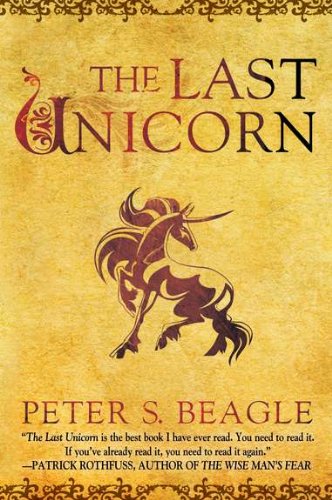
Obviously I must read it again at some point, though, if not right this instant. Not only would I want to because the book is good, but Patrick Rothfuss says I should read it again. It's right there. On the cover.

Speaking of Patrick Rothfuss, as one can tell from the cover, he, um, very very much likes it. He talks about it a lot, but this is one of my favorites that I could find... language warning, but... yeah. The part at the top, before he gets to Tad Williams, though the whole thing is good.

Oh, one other thing. So beautiful it hurts, sure. But... there's humor, whimsy, silliness, too. It's not all dignified or quite what you would expect. It's an odd blend, but again, pretty much perfect.

I mean, the incompetent magician is named Schmendrick. Yeah. It's hard to be very dignified with a name like that. And he pretty much is the incompetent magician, the standard by whom all others shall be judged. In the words of my edition's generic blurb, "...a kind of poor man's Merlin whose devotion to the exquisite creature he follows is exceeded only by his mediocrity in magic."

Beautiful, beautiful, beautiful book.


"'How can it be?' she wondered. 'I suppose I could understand it if men had simply forgotten unicorn [sic] or if they had changed so that they hated all unicorns now and tried to kill them when they saw them. But not to see them at all, to look at them and see something else--what do they look like to one another, then? What do trees look like to them, or houses, or real horses, or their own children?'

"Sometimes she thought, 'If men no longer know what they are looking at, there may well be unicorns in the world yet, unknown and glad of it.' But she knew beyond both hope and vanity that men had changed, and the world with them, because the unicorns were gone. Yet she went on along the hard road, although each day she wished a little more that she had never left her forest."


"'It's a rare man who is taken for what he truly is,' he said. 'There is much misjudgment in the world. Now I knew you for a unicorn when I first saw you, and I know that I am your friend. Yet you take me for a clown, or a clod, or a betrayer, and so must I be if you see me so. The magic on you is only magic and will vanish as soon as you are free, but the enchantment of error that you put on me I must wear forever in your eyes. We are not always what we seem, and hardly ever what we dream. Still I have read, or heard it sung, that uncorns [sic] when time was young, could tell the difference 'twixt the two--the false shining and the true, the lips' laugh and the heart's rue.'"

And on a smaller scale, a good representative phrase I noticed and loved: "When Schmendrick looked at her again he had managed to pull his face together, but it was still struggling to escape from him."

The rest of what I'm going to quote is scented faintly of spoilers, so to those who are sensitive to those strains, read no further. They are so good (and so sideways to any true spoilers) that I can't help myself. I quote on, for the beautiful, beautiful themes.


"'Fools, fools and children! It was a lie, like all magic! There is no such person as Robin Hood!' But the outlaws, wild with loss, went crashing into the woods after the shining archers, stumbling over logs, falling through thorn bushes, wailing hungrily as they ran.

"Only Molly Grue stopped and looked back. Her face was burning white.

"'Nay, Cully, you have it backward,' she called to him. 'There's no such a person as you, or me, or any of us. Robin and Marian are real, and we are the legend!'"


"'The hero has to make a prophecy come true, and the villain is the one who has to stop him--though in another kind of story, it's more often the other way around. And a hero has to be in trouble from the moment of his birth, or he's not a real hero. It's a great relief to find out about Prince Lír. I've been waiting for this tale to turn up a leading man.'

"The unicorn was there as a star is suddenly there, moving a little way ahead of them, a sail in the dark. Molly said, 'If Lír is the hero, what is she?'

"'That's different. Haggard and Lír and Drinn and you and I--we are in a fairy tale, and must go where it goes. But she is real. She is real.'"


"'...How can anything that is going to die be real? How can it be truly beautiful?'...

"'I was born mortal, and I have been immortal for a long, foolish time, and one day I will be mortal again; so I know something that a unicorn cannot know. Whatever can die is beautiful--more beautiful than a unicorn, who lives forever, and who is the most beautiful creature in the world.'"


There. It's alright, you can come out now. I'm done.

Thursday, May 30, 2013

Blackbringer

Installment #4 in the Book Reviews for Melanie series.

Blackbringer
(Dreamdark #1) by Laini Taylor
Read: 12/9/11-12/11/11
Click here for my sister Sondy's review


"Four pairs of battered canvas shoes were arranged around the table with their toes pointed inward, as if the fishermen had gathered here to open the bottle they'd pulled up in their nets. Whatever had been inside, it had been there for a long, long time, and it had come out hungry. Calypso whistled low. 'Snatched 'em right out of their slippers,' he said.

'Why'd they let it out?' Pup wanted to know. 'Why do they always?'

'I reckon they heard the story about the wishes,' replied Swig.

Magpie sighed. One devil, just one in all of devil history, had granted three wishes to the human who freed it. Magpie had caught that troublemaking snag five years ago and put him back, but the damage was already done. The mannies had a mania for it now, and every chance they got they freed some wicked thing back into the world, and they surely didn't get wishes for their trouble.

What had these fools gotten? Just their shoes left behind, and no one to spread that story. 'Poor dumb mannies,' she muttered.

'Curiosity killed the eejit,' Calypso replied with a shrug.

Magpie frowned at him. Usually pity was the last emotion humans inspired in her, but something about those empty shoes tugged at her heart."


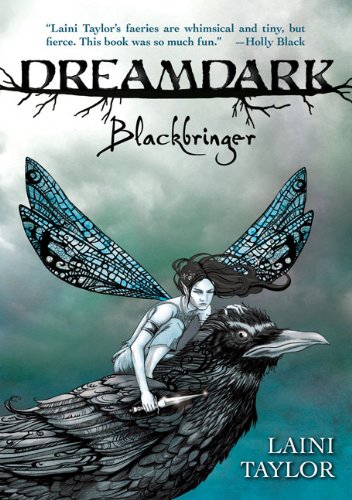
Magpie Windwitch is a faerie who hunts devils with her crow friends. As the Holly Black quote on the cover says, "Laini Taylor's faeries are whimsical and tiny, but fierce. This book was so much fun."

"Many thousands of years ago, when the faeries had at long last won the wars, the seven champions had captured the devils in bottles and cast them into the sea. They had crafted elaborate magicks so that nothing could ever free them from their prisons--nothing then alive in the world, anyway. Not faerie nor dragon, elemental, snag, creature, imp, or finfolk could break those seals. But humans? Humans didn't exist. And then one millennium along they came, fishing the world's oceans, pulling up ancient bottles in their nets and uncorking them to see what was inside.

Now devils were creeping back into the world, faster and faster all the time, but the age of champions was long past, and little Magpie Windwitch found herself alone against them."

Blackbringer is, like The Name of the Star, the only book by its author that I've read, despite its excellence. Unfortunately, encouraging you to read Blackbringer seems a bit to me like encouraging you to watch a canceled TV show. Well, who am I kidding? How could I not demand you watch Firefly this instant, if you hadn't already?

See, there is a sequel, though it's out of print, but according to Laini Taylor's website, the third book... well, that's made it onto a very short FAQ list. However, it may be written, at some point! I can't say for sure, but I feel like when I first checked her site, after reading Blackbringer, there were publisher complications that made it sound much bleaker than "I have every intention of returning to complete the Dreamdark series." Still, "...it is not now on the slate." So. Sadly incomplete story. Well. I mean, it doesn't end on a cliffhanger, as I recall. It's complete, as far as it goes. One just... wants more.

That said, what a world, what characters, what a voice! Magpie is a faerie, but she's... well, in that severely overused phrase of paranormal romance and urban fantasy reviews, a "kickass heroine." But she doesn't at all give you that feeling some of them do, that someone's just trying so very hard to create a strong female character. She feels real, she's just a very feisty real. A tiny little warrior saving the world from demons. Yeah, I kind of fell in love with her.

Picked this one up used from the bookstore when I worked there, because I'd seen Laini Taylor's name before, on Shannon Hale's blog, I think. Ah yes, Shannon Hale interviewed her... five years ago, is all. I am so on top of things.

It should perhaps be noted that there are many other things this book does extremely well, as I started to remember when I looked through the quotes I'd marked down. That's what happens when you write about a book a year and a half after reading it, but I will leave as is. These are some of the things that stuck with me.

Must read again... get sequel...

Wednesday, May 15, 2013

The Name of the Star

Installment #3 in the Book Reviews for Melanie series.

The Name of the Star (Shades of London #1) by Maureen Johnson
Read: 12/17/11-12/18/11
Click here for my sister Sondy's review

I first heard of Maureen Johnson when I joined twitter and my sister Sondy told me to follow her because she was the funniest person on twitter. She was right.

And yet, for no apparent reason, I've only read one of her books so far. This must be remedied.

The Name of the Star is that one book. A friend gave it to me as an early Christmas present in 2011, for which I am grateful. Melanie, you should read it. It's even on our Kindle account. (I should read the sequel that came out a couple months ago, The Madness Underneath. And, well, her other books, in other series.)

Melanie, you know how when a book starts out in the "normal world" and then shifts to fantasy, the normal world part tends to be kind of boring and annoying, with the exception of The Chronicles of Narnia? Even books that I really really like, like Garth Nix's Abhorsen Trilogy?

Well, The Name of the Star doesn't move from one world to another, but the main character's eyes are opened to a different world underneath the surface of her normal world, so it more or less fits in with the category.

And I'll admit, the weirder it got, the more I liked it. It just got better and better. But boring normal world? Not so much. What saves it here is Maureen Johnson's voice. Of course, having followed her on twitter, I should've known her books would be funny, and the voice would be awesome! How could they not be?

For example, take this quote from the beginning of the book (only a map and the intro come before this):

"If you live around New Orleans and they think a hurricane might be coming, all hell breaks loose. Not among the residents, really, but on the news. The news wants us to worry desperately about hurricanes. In my town, Bénouville, Louisiana (pronounced locally as Ben-ah-VEEL; population 1,700), hurricane preparations generally include buying more beer, and ice to keep that beer cold when the power goes out. We do have a neighbor with a two-man rowboat lashed on top of the porch roof, all ready to go if the water rises--but that's Billy Mack, and he started his own religion in the garage, so he's got a lot more going on than just an extreme concern for personal safety.

"Anyway, Bénouville is an unstable place, built on a swamp. Everyone who lives there accepts that it was a terrible place to build a town, but since it's there, we just go on living in it. Every fifty years or so, everything but the old hotel gets wrecked by a flood or a hurricane--and the same bunch of lunatics comes back and builds new stuff."

Or, another long one... (I'm sorry, I read it again as I was going through my highlights, and I just can't resist!) Um, to understand some of the quotes that follow, you should know that the main character, Rory, leaves Louisiana to study abroad, in England. So.

"I know you're not supposed to judge people when you first meet them--but sometimes they give you lots of material to work with. For example, she kept looking sideways at my uniform. It would have been so easy for her to say, 'Take a second and change,' but she hadn't done that. I guess I could have demanded it, but I was cowed by her head girl status. Also, halfway down the stairs, she told me she was going to apply to Cambridge. Anyone who tells you their fancy college plans before they tell you their last name... these are people to watch out for. I once met a girl in line at Walmart who told me she was going to be on America's Next Top Model. When I next saw that girl, she was crashing a shopping cart into an old lady's car out in the parking lot. Signs. You have to read them.

"I was terrified for a few minutes that they would all be like this, but reassured myself that it probably took a certain type to become head girl. I decided to deflect her attitude by giving a long, Southern answer. I come from people who know how to draw things out. Annoy a Southerner, and we will drain away the moments of your life with our slow, detailed replies until you are nothing but a husk of your former self and that much closer to death."

And then there's:

"These people didn't seem rich--at least, they weren't a kind of rich I was familiar with. Rich meant stupid cars and a ridiculous house and huge parties with limos to New Orleans on your sixteenth birthday to drink nonalcoholic Hurricanes, which you swap out for real Hurricanes in the bathroom, and then you steal a duck, and then you throw up in a fountain. Okay, I was thinking of someone very specific in that case, but that was the general idea of rich that I currently held."

"'You don't say much, do you?' Jerome asked me.

No one in my entire life had ever said this about me.

'You don't know me yet,' I said.

'Rory was telling me she lives in a swamp,' Charlotte said.

'That's right,' I said, turning up my accent a little. 'These are the first shoes I've ever owned. They sure do pinch my feet.'"

Okay, that's enough of that. I read some more of my highlights, but not all of them. I must not read all of them at this time, or this review will get too long. ("Goodbye, Thing. Your [review] is too long." No, I know it doesn't have quite the same ring to it.)

However, if you scroll back up to the top and click on the link to read Sondy's review (Oh, or wait, here it is again! Where'd that come from?), she does include another quote that I was tempted to use in mine. Two for the price of one! Or something. Overall, she more or less says the same things I do about the book, but in a different way, and better. And a little more of the plotty premise details.

What is the book actually about? Well, it's technically YA, though I generally don't concern myself much with those age categorizations. And it's a mystery involving Jack the Ripper lookalike murders. If you haven't read much about Jack the Ripper, his murders were pretty gruesome. I didn't realize. Um, don't google him, if you don't want to know more. The book seemed sufficient, to me. Anyway. The Name of the Star is also about... weird elements. I'm not going to specify more than that, to avoid giving even a teensy bit of a spoiler. But I really liked how the mechanics of the weird elements were worked out. Good strong worldbuilding.

Dang it, no teensy spoiler means I can't use one of the book review category tags I wanted to use. Oh well.

Have fun!

Thursday, April 11, 2013

The Eyre Affair

Installment #2 in the Book Reviews for Melanie series!

Yeah, I'm behind. To do two a month, I should do five more before much time passes...

Well, here's another quick, non-perfectionistic one to get the ball rolling. I started talking about The Eyre Affair on facebook, recommending it to Melanie, and it occurred to me that I should have said those things here, instead. So when I thought of more comments to add, I restrained myself. Melanie, here's the rest of what I have to say about it. Well, not the rest of what I have to say for all time and eternity, but you know. For the moment.


The Eyre Affair (Thursday Next #1) by Jasper Fforde
Read: 2/12/13-2/18/13
Click here for my sister Sondy's review

The part from facebook:

So, I've only read the first one so far, The Eyre Affair, but I'm pretty sure it's among the most unique books I've read. It has... a bit of a familiar feel, but I think part of that is from the bits of the premise I've heard from other people. And partly because of the way anything really well done can feel familiar. I mean, it has time travel, alternate history (because of course! time travel!), a pliable barrier between fiction and reality occasionally allowing characters out and real people in, a world so full of bibliophiles that... well, put it this way:

"I was what we called an 'operative grad I' for SO-27, the Literary Detective Division of the Special Operations Network based in London. It's way less flash than it sounds. Since 1980 the big criminal gangs had moved in on the lucrative literary market and we had much to do and few funds to do it with."

Okay, since I started, a couple other amusing bits:

"'So Napoleon won at Waterloo, did he?' he asked slowly and with great intensity.

'Of course not,' I replied. 'Field Marshal Blücher's timely intervention saved the day.'
I narrowed my eyes.
'This is all O-level history, Dad. What are you up to?'
'Well, it's a bit of a coincidence, wouldn't you say?'
'What is?'
'Nelson and Wellington, two great English national heroes both being shot early on during their most important and decisive battles.'
'What are you suggesting?'
'That French revisionists might be involved.'
'But it didn't affect the outcome of either battle,' I asserted. 'We still won on both occasions!'
'I never said they were good at it.'"

Making this even more funny (to me, anyway), it's a bit of a throwaway scene, seemingly at least. Doesn't have much to do with the plot of this book, though it definitely could be setting up some things later.

"'I have lots of hobbies.'
'Name one.'
'Painting.'
'Really?'
'Yes, really. I'm currently painting a seascape.'
'How long has it taken you so far?'
'About seven years.'
'It must be very good.'
'It's a piece of crap.'"

"'Did the memory erasure device work, Uncle?'
'The what?'
'The memory erasure device. You were testing it when I last saw you.'
'Don't know what you're talking about, dear girl.'"

Technically I suppose it'd be fantasy or science fiction (with the time travel, and other things explained as science, SF I suppose), but it's normally shelved with general fiction, as it doesn't exactly feel like normal fantasy or sci-fi. But it's good. Invites comparisons to all sorts of other things, but isn't really quite like any of them. I think they're mostly brought up because it's unique, and thus hard to describe in the normal ways. So you have reviews that say things like, "...combines elements of Monty Python, Harry Potter, Stephen Hawking and Buffy the Vampire Slayer." (Wall Street Journal)


Now for the non-facebook part:

First, another fun quote:

"...Several people have asked me where I find the large quantity of prepositions that I need to keep my Bookworms fit and well. The answer is, of course, that I use omitted prepositions, of which, when mixed with dropped definite articles, make a nourishing food. There are a superabundance of these in the English language. Journey's end, for instance, has one omitted preposition and two definite articles: the end of the journey. There are many other examples, too, such as bedside (the side of the  bed) and streetcorner (the corner of the street), and so forth. If I run short I head to my local newspapers, where omitted prepositions can be found in The Toad's headlines every day. As for the worm's waste products, these are chiefly composed of apostrophes--something that is becoming a problem--I saw a notice yesterday that read: Cauliflower's, three shilling's each..."

Personally, I find the beginning bit about "omitted prepositions" a little silly, as the other is a perfectly viable alternative genitive form. But the bit about the headlines is amusing, and I definitely like the bit about the apostrophes as waste products!

The book reminded me a little, I thought, of The Phantom Tollbooth, but I wasn't very sure of that, as it's probably been decades since I've read it. (A problem to rectify, especially as it was one of my 2012 Christmas presents.) But I mentioned it to another friend who's read both, and she confirmed my suspicions. There are similarities. No wonder The Eyre Affair feels both so familiar and unique! Among other reasons.

Quite a whimsical, enjoyable book. Thoroughly fun. Especially the better you know your literature and history. I had a feeling there were many jokes I wasn't getting, but it works either way. Fforde scatters his jokes liberally, not pausing to make sure you get them, and there's no harm if you don't catch some. They only improve an already great read.

I like the style of the humor -- I thought the passages I quoted above were even more funny, given that, as I said for one of them, they were almost throwaway scenes, not made much of. He just goes on. After, "'Don't know what you're talking about, dear girl,'" they immediately talk about something completely different. It's awesome.

That style with the alternate history, too -- I love that we get Thursday's (the main character's) POV, not her father's (who time travels), and the changes are just things that seem normal to her. We don't even know her full "normal," how she'll react to her father's questions. Nor do we know which differences from our timeline will be a result of certain time tamperings, and which will be different before time travel actions. And which will just stay the way they are, or not be explained. It's all, as I said, pretty awesome. More than I'm making it sound.

I've heard some of the sequels are better, and I believe it -- don't get me wrong, this one is very good, but there's a feeling in it of potential, not fully tapped.

So go, read, have fun. I have so many books I'm in the middle of right now, but I really need to get my hands on the sequels.

Wednesday, January 16, 2013

Book of Enchantments

I didn't give many Christmas presents this year. At least, not yet. And by "many" I mean "more than one." See, there was this baby...

But my sister Melanie had a present on her wish list that I just couldn't resist. She said she had so many books available to read, especially on our family's Kindle account, that she'd like someone to give her the gift of time by reviewing some of those Kindle books, or other favorites of theirs; helping her to decide which ones to read. So I sent her a long list of books I've been meaning to review, and she told me which ones she hadn't read.

I didn't promise many, or well, any, really. I didn't want to make a promise I can't keep, and being a new mother, I'm pretty unsure about how much I could possibly promise and keep. But I'm going to aim to review a couple books every month for this whole year. I'm looking forward to telling you what to read, Melanie!

Maybe occasionally I'll also review something she has read, a couple of those books on my sidebar. Be nice for that to-review list to stop growing longer and longer and longer...

Melanie, I hope you don't have too hard of a time obtaining copies of the books I review. Many of them may not be on the Kindle account, so I may not help you much with selecting books there after all... meh.

I'm going to start the series out with an easy one, a review that I'd drafted which had moldered away on here without getting posted for no apparent reason. Last date I edited it was 10/5/10, that may be when I wrote most of it. Melanie, enjoy! And the rest of you, too!


Book of Enchantments by Patricia C. Wrede
Read: 7/29/10-8/26/10
Click here for my sister Sondy's review

If you like Patricia C. Wrede (and why wouldn't you?) I recommend picking up this collection of short stories sometime. If you've never read any of her books, I suggest starting with Dealing with Dragons, although you don't have to, and although I haven't read all her books, so I don't say that with complete authority. It's just that there were a few stories in the collection I wasn't crazy about, which makes Dealing with Dragons of a higher consistent quality. And there was a story about the Enchanted Forest characters which "spoils" who ends up with who. I put it in quotation marks because it's one of those obvious pairings, and the suspense in that respect isn't what makes the stories.

Book of Enchantments was copyright 1996. There are ten stories from rather various sources, conveniently detailed in Notes from the Author at the back. The original stories range all the way from 1981 up to the one story written for the collection, which I'm guessing, even if the publishing process was long (well, of course, it would be, it always is), would have been written in 1995 at the earliest. She talks about them in the order she wrote them rather than the order they're presented in the book -- it isn't the same order, although there are rough similarities. Swap a couple of the middle ones, move the oldest story in between them, move one of the newer ones towards the start, and you're all good. But anyway.

Four of the stories were written for anthologies -- a Liavek "shared world" anthology, a unicorn anthology put together by Bruce Coville, a Witch World anthology and a werewolf anthology put together by Jane Yolen, although it didn't end up making the cut for reasons of a humorous story not fitting with the tone. Oddly enough, of those four stories, only the Witch World one, "The Sword-Seller," felt very unlike Wrede's normal style. It was more dramatic and less humorous than her norm, but still good. I wouldn't pick up the book just for that one, but nonetheless, likable. On the other hand, out of the six stories not written for anthologies, maybe as many as four of them felt a little un-Wrede-like to me. Obviously I am not familiar with all the styles of Wrede. And I know, she is allowed to do dramatic and not just humorous. But I think I would prefer longer work for her dramatic, novels instead. Still, I guess some of the dramatic stories with nice premises or twists worked quite well. "Stronger Than Time" was a great Sleeping Beauty twist. But then, maybe because it was connected to a fairy tale, it was one of the ones that felt Wrede-like to me, despite not being laugh-out-loud funny. Meh. I'm so putting her in a box. Sorry, Patricia C. Wrede!

My favorites were the ones that felt totally like her to me -- "Rikiki and the Wizard," "The Princess, the Cat, and the Unicorn," and "Utensile Strength." Probably in fourth would be "The Sixty-Two Curses of Caliph Arenschadd." These stories were awesome.

"Rikiki and the Wizard" was the one I mentioned earlier was written for a Liavek anthology, which is why its subtitle is "A S'Rian Folk Story" -- I never would have guessed that the blue chipmunk god in this story was not Wrede's own creation, but no, she says in the Notes, "I had spent a good portion of one morning reading a book of American Indian folktales and had started wondering what sort of folk stories the Liavekans might tell each other, particularly about their not-too-bright chipmunk god, Rikiki."  Who would have thought someone else would have thought of such a thing?  At any rate, the story was hilarious. I ended up starting to read portions aloud to others in the room, but then going back and reading the tiny bit at the beginning I'd skipped and then reading the whole thing aloud. It was good.

It's more obviously understandable why I recognize and love the style in "The Princess, the Cat, and the Unicorn" and "Utensile Strength," as they're both set in the Enchanted Forest. The first was another read-aloud good one -- the cat of the title is so wonderfully cat-like ("'How would you like to have your tail stepped on?' 'I don't have a tail,' Elyssa said, considerably startled. 'And if you hadn't been lying in front of me, I wouldn't have stepped on you.' 'Cat's privilege,' said the cat, and began furiously washing his injured tail.'"), the unicorn is... well, to quote the Notes,

"Naturally, Enchanted Forest unicorns would be beautiful and magical and intelligentbut, being intelligent, they would certainly know just how beautiful and magical they were, and would expect to be treated accordingly..." ("'Gracious!' Elyssa said. 'Yes I am, aren't I?' said the unicorn complacently.')

And as for "The Princess" part of the title, I think I shall simply quote again, from the beginning of the story, this time. That seems best and most enjoyable.

"Princess Elyssa and her sisters lived in the tiny, comfortable kingdom of Oslett, where nothing ever seemed to go quite the way it was supposed to. The castle garden grew splendid dandelions, but refused to produce either columbine or deadly nightshade. The magic carpet had a bad case of moths and the King's prized seven-league boots only went five-and-a-half leagues at a step (six leagues, with a good tailwind).

There were, of course, compensations. None of the fairies lived close enough to come to the Princesses' christenings (though they were all most carefully invited) so there were no evil enchantments laid on any of the three Princesses. The King's second wife was neither a wicked witch nor an ogress, but a plump, motherly woman who was very fond of her stepdaughters. And the only giant in the neighborhood was a kind and elderly Frost Giant who was always invited to the castle during the hottest part of the summer (his presence cooled things off wonderfully, and he rather liked being useful).

The King's councillors, however, complained bitterly about the situation. They felt it was beneath their dignity to run a kingdom where nothing ever behaved quite as it should. They grumbled about the moths and dandelions, muttered about the five-and-a-half-league boots, and remonstrated with the Queen and the three Princesses about their duties...

'It's all very well for a middle Princess to be ordinary,' the chief of the King's councillors told her in exasperation. 'But this is going too far!'...

But the councillors refused to give up. They badgered and pestered and hounded poor Elyssa until she simply could not bear it anymore. Finally she went to her stepmother, the Queen, and complained.

'Hmmph,' said the Queen. 'They're being ridiculous, as usual. I could have your father talk to them, if you wish.'

'It won't do any good,' Elyssa said.

'You're probably right,' the Queen agreed, and they sat for a moment in gloomy silence.

'I wish I could just run off to seek my fortune,' Elyssa said with a sigh.

Her stepmother straightened up suddenly. 'Of course!  The very thing. Why didn't I think of that?'

'But I'm the middle Princess,' Elyssa said. 'It's youngest Princesses who go off to seek their fortunes.'

'You've been listening to those councillors too much,' the Queen said. 'They won't like it, of course, but that will be good for them.' The Queen was not at all fond of the councillors because they kept trying to persuade her to turn her stepdaughters into swans or throw them out of the castle while the King was away."


And as for "Utensile Strength," well, it's a story about the Frying Pan of Doom. Need I say more?  No, but you can count on me wanting to. I mean, it's just so quotable.

"'And Mother says it was her best frying pan and now she's going to have to start all over breaking in a new one, because you can't cook chicken in the Frying Pan of Doom. It just wouldn't be right.'"

"'Heroes want a weapon that sounds heroic and magicalthe Thunder Mace or the Sword of Starsnot the Frying Pan of Doom. And on top of that... Well, here, try to touch it. But be careful.'

Gingerly, Daystar reached out and touched the side of the pan. 'Ow!  It's hot!'

Tamriff nodded. 'Nobody can pick it up unless they're wearing an oven mitt. And no hero wants to go into battle wearing an oven mitt and swinging a frying panor at least, none of the fifty-seven heroes Father has checked with so far.'"


Heh heh.

Wednesday, July 07, 2010

The Garden Behind the Moon

Read: 5/14/10
LibraryThing tags, if I had put this on LibraryThing: Children's, Fantasy, Fairy Tale, Victorian

I tag it as a fairy tale not because it's a traditional one, but because it has all the elements.

This is a more charming and less adventurous book than Howard Pyle's usual fare, I believe. Not that there isn't any adventure; it's just not The Merry Adventures of Robin Hood. It's a little reminiscent of George MacDonald -- Pyle was born only about thirty years after MacDonald, and it looks like he started writing (or publishing) about thirty years after MacDonald did, too. So roughly the same period, and "one of the late nineteenth-century writers who helped invent the fairy tale novel," as Jane Yolen put it (quoted on the back cover of my library copy), so it's not particularly surprising one would remind me of the other. Yay!

Now let's see if I can remember all the adjectives I was thinking of when I first finished the book. Hmm. Charming, I already mentioned that one. Beautiful, sad, and oh bother, one I could remember just yesterday, gaaah... I think it basically meant beautiful and sad (but not tragic!) at the same time, but still, the connotation is so much better than if you just use the two words... it started with an "m"... gaah. Delightful. No, it's not the word I'm looking for, but I think it was still one of the original adjectives. Sort of picturesque... Ah well. Someday I'm going to buy this book, a nice edition with all the original illustrations.

From the Foreword: "When you look out across the water at night, after the sun has set and the moon has risen high enough to become bright, then you see a long, glimmering moon-path reaching away into the distance. There it lies, stretching from the moon to the earth, and from the earth to the moon, as bright as silver and gold, and as straight and smooth as a turnpike road...

It looks like a path, and that is what it really is, for if you only know how to do so, you may walk upon it just as easily as you may walk upon a barn floor. All you need to do is to make a beginning, and there you are. After that it is smooth enough walking, and you may skip and play and romp as you choose. Then you may come and go whenever you have a mind to, and if you will take my word for it, it is the most beautiful and wonderful road that a body can travel betwixt here and the land that so few folk ever go to and come back again.

For the moon-path leads straight to the moon. That was why it was built -- that a body might go from the brown earth to the moon, and maybe back again.
But why, you may ask, should anybody want to go to the moon? That I will tell you. The reason is that behind the moon there lies the most wonderful, beautiful, never-to-be-forgotten garden that the mind can think of. In it live little children who play and romp, and laugh and sing, and are as merry and happy as the little white lambs in the green meadow in springtime. There they never have trouble and worry; they never dispute nor quarrel; they never are sorry and never cry.

Aye, aye; -- that beautiful garden. One time I myself saw it -- though in a dream -- dim and indistinct, as one might see such a beautiful place through a piece of crooked glass. In it was the little boy whom I loved the best of all. He did not see me, but I saw him, and I think I was looking into the garden out of one of the moon-windows. I was glad to see him, for he had gone out along the moon-path, and he had not come back again."

And from the end of the book (but without any spoilers, don't worry!): "Well, you may smile at this story if you choose, and call it all moonshine, but if you do not believe by this time that there is more in moonshine than the glimmer and the whiteness, why, I could not make you believe it if I were to write a hundred and twenty-seven great books instead of this short story."

Tuesday, April 27, 2010

The Hob's Bargain

The Hob's Bargain by Patricia Briggs
Read: 3/8/10-3/9/10
LibraryThing tags, if I had put this on LibraryThing: Fantasy, Romance, Ghosts

This is one of the ones I'll have to be a little bit vague about, plot-wise -- there are spoilers right from the beginning. They're not hard to feel coming, but still. That's different than having them blurted out in a review. Then there are other things it seems safe to say since they aren't really surprises per se; given that they happen at the beginning and are intrinsic to the plot, I'll go for it.

The main character, Aren, has the sight in a world very hostile to magic. If people find out you're "mageborn," you might just be killed, or you might have a choice -- to die or to become a bloodmage -- which involves killing and torturing and eventually going insane and basically rotting from the inside out. Fun stuff.

So needless to say, Aren isn't too happy about having the sight, and she doesn't go around telling people about it. As she puts it early on in the book, "Not very useful. If I had to be stricken with magic, I would rather have had something like Gram's talent for healing, or my brother's knack for finding things--especially because the consequences of having magic were so deadly."

But then her world changes (quite literally), magic is unbound, and wild magical creatures who haven't roamed the land in hundreds (or thousands? I forget) of years are about again, and of course no one in her village knows how to deal with them. To protect her people (including those of the villagers who hate her guts) from them and other threats which emerged with the changing of the world (or, in fantasy epic terms, with The Breaking of the World, I suppose -- seems like the way they might term it, far enough in the future)... well, cue the adventures of the rest of the book. Of course a bargain with a hob is involved, since that's the title. She has plenty of her own fighting to do though, aside from any bargains.

I liked the way Patricia Briggs dealt with believers in a One God suddenly having to appease nature spirits and such -- unlike the way most fantasy would have treated it, it was quite respectful to monotheism. In her hands, the whole thing was actually quite amusing.

And, of course, I loved the characters. Because I always love Patricia Briggs' characters, particularly her heroines. Maybe they're all the same -- wounded but strong -- but I don't care. That's general enough, they're distinguished in every other aspect. And they're all wounded in different ways and with different personality strengths. She strikes just the right balance for perfect empathy, admiration, inspiration... yep. Never obnoxious, just... strong.

I was sad when I realized this one's a stand-alone. A lot of her older ones come in twos, and I thought I'd heard someone talk about this one and its sequel, but... guess not. Very disappointing. Oh, well. I guess that makes it a good choice to start with if you haven't read any of her books before. And I have a copy I can loan out.

Monday, February 15, 2010

Heart's Blood

Heart's Blood by Juliet Marillier
Read: 1/7/10-1/27/10 (but only in about three sittings -- around 50 pages one day, the rest of it a few weeks later)
LibraryThing tags, if I had put this on LibraryThing: Fantasy, Romance, Fairy Tale, Historical Fiction, Ireland, Medieval, Family, Fear... and a couple other tags I won't include this time just in case it'd spoil things for a couple of you.

Perhaps the best way to introduce this book is with the author's own words (I will link to it only with the warning that the page includes spoilers, but I don't think the part I've copied here really spoils anything, unless you just don't want to know what a book is about at all before you read it, in which case, why are you here?):

"Beauty and the Beast has always been one of my favourite fairy tales, and readers will recognise the bones of it in Heart’s Blood: a mysterious house with an alienated, disfigured master, a priceless plant growing in a forbidden garden, magic mirrors and unusual household retainers. The story of my novel has the same general shape as that of Beauty and the Beast.

However, this is far from a fairy tale retelling. It’s not even a close reinterpretation of the traditional tale. Heart’s Blood is a love story, a... [Marcy just now realized one of the descriptions she uses could be a big spoiler to the right kind of brain and cut it] ...a family saga, a story about people overcoming their difficulties, and a little slice of Irish history, as well as a homage to a favourite fairy tale."

Aside from the magic mirrors and one other spoiler aspect, there isn't a great deal of the fantastic in this book, especially when one has "Beauty and the Beast" in mind while reading it. It had a gothic feel to me (
although I'm not widely read in gothic literature), even more so than some of the traditional retellings, which seems a little odd now that I think of it. I suppose when there's already a beast in an isolated castle you don't want to make the tale too dark, or the happy ending begins to feel implausible. And I suppose it made particular sense for Heart's Blood, because one of the main themes concerns facing your fears, so a dark, frightening mood lends itself to the theme.

And now you're going to think it's horror or something. Not so much. It's fantasy, romance, and historical fiction; in that order, I think. Maybe more romance than fantasy, but not enough that you would ever want to shelve it there. Heavens, no. For starters, fantasy readers don't like going into the romance section, whereas the reverse is not true. Romance is one of those things... any genre can have a pretty huge dose of it without necessarily offending its readership or moving it in the bookstore. Anywho.

As for the historical fiction, it's set in western Ireland, Connacht, in the twelfth century. Dang it, I started a new paragraph, but that's really all I have to say about that. Huh. I mean, I could say more about the period, but I don't really need to for my purposes, and I'd risk spoilers. So meh. You can read more about it (on the author's page, or elsewhere) after you finish the book.

I didn't like it quite as much as some of her other books, but that isn't saying much, as Daughter of the Forest and Wildwood Dancing are among my favorites. I'm not quite sure why I didn't like it as much. It was certainly well written and enjoyable. It just didn't have that extra something those two did, to flabbergast and amaze me. Maybe the themes and characters didn't speak to me as much? And yet, I did like and relate to them; the hero not as much as other characters, perhaps, maybe that's it. Maybe I stayed too busy thinking about the book instead of living it. I'm really not sure. It was very good. I wouldn't be particularly surprised if other readers fell in love with it.

Tuesday, February 02, 2010

On the Edge

On the Edge (The Edge #1) by Ilona Andrews
Read: 12/8/09-12/9/09
LibraryThing tags, if I had put this on LibraryThing (I'm currently at the max number of books I can add for free -- the lifetime upgrade doesn't cost much, but still, not doing it yet): Fantasy, Urban Fantasy, Rural Fantasy, Romance, Georgia, Atlanta

The most recent of Ilona Andrews' (actually two people, a husband and wife team) books and the first of a new series, I read the first two books in her (agh, I mean their) Kate Daniels series before this, but I'm reviewing this one first because I need to return it to the library.

The first order of business is to explain my "rural fantasy" tag. It's a slightly misremembered term, on my part, from the original "rustic fantasy" the husband in the writing team came up with:
"The first hint of trouble came when Gordon edited it and took to calling it 'rustic fantasy' as opposed to urban fantasy." At first I thought this was just silly. I mean, I can tell what the point is, but isn't that ridiculously redundant? And yeah, "urban fantasy" sounds like it should be urban, but in reality the sub-genre is basically defined as our modern contemporary world with fantasy elements -- often with vampires and werewolves, often urban, pretty often with large doses of romance and mystery, but those aren't the defining points. So okay, "rustic" or "rural fantasy" is going to be those, only set somewhere in the country, right?

After reading it, I decided it's an oddly appropriate classification. It's so appropriate, I don't know if anyone else will ever write a book that fits the category as well as this, but oh well. See, even though your standard fantasy fare generally is set in the country, On the Edge feels even more rural than that! How so? It reminded me of things I've heard about the Appalachians, for starters.

In this world, you have the Broken, the Edge, and the Weird. The Broken is our world, complete with Wal-Marts. The Weird is a place where blueblood aristocrats rule. Magical strength is very important in the Weird, and the aristocrats tend to have it. Magic isn't usable in the Broken, making magic users from the Edge or the Weird feel broken, hence the name. The Edge is the long, long, long strip of land between the Broken and the Weird. Most people in the Broken don't know about the Edge or the Weird, wouldn't be able to see the boundary. And for people in the Weird, it's painful to cross to the Edge, and possibly fatal to cross to the Broken. People on the Edge have to have sufficient magic to cross to the Weird. If those from the Weird succeed in crossing to the Broken, there's the danger of losing their magic if they stay long enough, and not being able to cross back.

Edgers -- well, they could easily remind one of white trash, only the main character, Rose, is way way way too likeable for me to ever want to call her that. Their culture makes a lot of sense, given that they're isolated from the rest of the world, with no police force. It's like what I've heard small towns are like, with plenty of people rubbing each other the wrong way, but they have their own ways of dealing with it to avoid blood feuds between their clans. And they're poor, because if you're born on the Edge you don't have a proper Broken birth certificate, and that means you work the same kinds of jobs any illegal alien works.

So, that's your basic world premise. I won't get into the main character's premise, that's another bundle of explanation. Not too much for the book -- the exposition is handled just fine -- but a bit much for one review.

Besides finding the world fascinating, did I like it? Yes, definitely. Some of the situations for the romance were a bit of a stretch, a little silly, but some of the later explanations helped. And I liked the characters. The main character, Rose, takes care of two little brothers I thought were awesome. I'd tell you all about them, long review or no, but I don't want to spoil it. Oh, and the novel's hook was great. A wonderful first page, a wonderful first three pages, and then just try to put it down. There were several places that made me laugh out loud, great lines and scenes. I'll see what I can quote without ruining anything. Hmm. Well, this isn't the best of them, but it had me cracking up. For all you manga fans out there:


“She barely had a chance to taste her first cup of coffee when Georgie wandered out of his room, sleepy eyed, his hair tousled. He ambled over to the window and yawned.


‘Would you like some Mini-Wheats?’ she asked.


He didn’t answer.


‘Georgie?’


Georgie stared out of the window. ‘Lord Sesshomaru.’


The demon brother from their comic book? ‘I’m sorry?’


‘Lord Sesshomaru,’ he repeated, pointing through the window.


Rose came to stand behind him and froze. A tall man stood at the edge of the driveway. A cape of gray wolf fur billowed about him, revealing reinforced-leather armor, lacquered gray to match his cape, and a long elegant sword at his waist. His hair was a dark, rich gold, and it framed his face in a glacial cascade that fell over his left shoulder without a trace of a curl.”


This one amused me, too:

“His gaze snagged on her Clean-n-Bright uniform. ‘Why are you wearing that?’

‘It’s my uniform. Everyone in my company wears it.’

‘It’s hideous.’


Rose felt her hackles rise. The neon green uniform was hideous, but she didn’t appreciate him pointing it out. She opened her mouth.

‘Yet despite it, you look lovely,’ he said.

‘Flattery will get you nowhere,’ she told him.


‘It’s not flattery,’ he said coldly. ‘Flattery requires exaggeration. I’m merely stating a fact. You’re a beautiful woman wearing an ugly sack of unnatural color.’”