Showing posts with label br: Benedictine. Show all posts

Wednesday, May 09, 2018

Begin Again Part 2


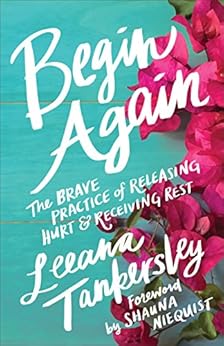
Begin Again: The Brave Practice of Releasing Hurt and Receiving Rest by Leeana Tankersley
Read: 4/7/18-4/24/18

Last week I started to tell how I found this book, and about my grief with my mother in the late stages of dementia.

I left off with listening to The Next Right Thing podcast, the episode Be a Beginner.

I'd just been told, by multiple people, that I didn't know how to do this, how to proceed, because I'd never done it before.

So this week, if you're in your own grief, anxiety, or transition, I invite you in with these words from the transcript:

"If you are newly engaged or newly pregnant or if you are a new step-parent or just moved into a new house, you are grateful for the new role that you have and maybe excited about the future. But there’s a lot you don’t yet know and there isn’t a handbook to teach you.

Wednesday, May 02, 2018

Begin Again Part 1


Begin Again: The Brave Practice of Releasing Hurt and Receiving Rest by Leeana Tankersley
Read: 4/7/18-4/24/18

This book is based on/inspired by the line in the Rule of St. Benedict, "Always we begin again." I absolutely loved it and would recommend it to everyone, but especially anyone who's in transition now, and especially especially anyone who's grieving anything.

Why? It's not a book on grief, right? I mean, "Hurt" is in the title, but "Releasing Hurt?" What if you just lost someone and the thing you're beginning is grief, and you're not ready to be done with that process yet?

This isn't a book that only applies to happy beginnings. Beginnings also involve endings, even the "my world is falling apart" sort.

I could give you a beautiful quote from the introduction to prove it, but first, let me tell you a story.

Here's how I found Begin Again. What I've written so far, anyway, and we'll finish the story and review next week. (Hopefully, that's the plan.)


My mom isn't doing very well. Nothing especially new there, but she's at a stage of not doing well that seems to be closer to the end, and I've been surprised at how hard it's been hitting me.

Monday, July 14, 2008

The Quotidian Mysteries

The Quotidian Mysteries: Laundry, Liturgy and "Women's Work" by Kathleen Norris
Read: 7/4/08-7/14/08
LibraryThing tags: Theology, Benedictine, Spiritual Disciplines, Life Management

I was already intrigued by this book, which I'd seen at work, and then it was recommended in another book I read and liked, Receiving the Day, reviewed here. It's a quiet, rambling sort of book, good for meditating on. It doesn't go directly to any point, but is full of good thoughts. It talks about the precious value of the everyday, while at the same time very much acknowledging the many frustrations of the everyday. Reading it made me want to read another one of her books, The Cloister Walk. It confirmed my musings on the spiritual value of our mortality, our neediness. And on FlyLady!


“The Christian religion asks us to place our trust not in ideas, and certainly not in ideologies, but in a God who was vulnerable enough to become human and die, and who desires to be present to us in our everyday circumstances. And because we are human, it is in the realm of the daily and the mundane that we must find our way to God.”


“Ironically, it seems that it is by the means of seemingly perfunctory daily rituals and routines that we enhance the personal relationships that nourish and sustain us. I read recently, in Martin Marty’s newsletter, ‘Context,’ of a study that monitored the habits of married couples in order to determine what made for good marriages. The researchers found that only one activity seemed to make a consistent difference, in terms of the ability to maintain a stable, happy, long-lasting relationship, and that was simple affection, the embracing or kissing of one’s spouse at the beginning and the end of each workday.

Most significantly, as Paul Bosch, the author of the article reports, ‘it didn’t seem to matter whether or not in that moment the partners were fully “engaged” or even sincere! Just a perfunctory peck on the cheek seemed to be enough—enough to make a difference in the quality of the relationship!’ Bosch comments, wisely, that this ‘should not surprise churchgoers. Whatever you do repeatedly,’ he writes, ‘has the power to shape you, has the power to make you over into a different person—even if you’re not totally “engaged” in every minute!’”