Showing posts with label Mom. Show all posts

Wednesday, May 15, 2019

Wrapping Up? (It Gets Better Part 4)


I closed Part 3 by telling you "how badly my mom was doing began to really hit me," complete with that link. If you haven't read it yet, you can click over and do that now -- it's essentially Part 4 of this story, and this post labeled Part 4 should be Part 5. Not confusing at all!

But I didn't say in that link how the trip down to California to say goodbye to my mom went, because it hadn't happened yet.


I absolutely love this picture. Somehow, amazingly, it shows joy and laughter as I sit by my mom, who's dying, and by my baby, who by the grace of God is whole and healthy even though her organs are in weird places.

Wednesday, May 09, 2018

Begin Again Part 2


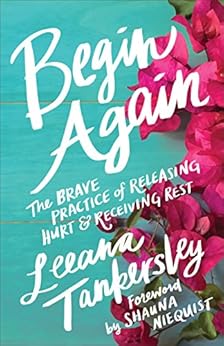
Begin Again: The Brave Practice of Releasing Hurt and Receiving Rest by Leeana Tankersley
Read: 4/7/18-4/24/18

Last week I started to tell how I found this book, and about my grief with my mother in the late stages of dementia.

I left off with listening to The Next Right Thing podcast, the episode Be a Beginner.

I'd just been told, by multiple people, that I didn't know how to do this, how to proceed, because I'd never done it before.

So this week, if you're in your own grief, anxiety, or transition, I invite you in with these words from the transcript:

"If you are newly engaged or newly pregnant or if you are a new step-parent or just moved into a new house, you are grateful for the new role that you have and maybe excited about the future. But there’s a lot you don’t yet know and there isn’t a handbook to teach you.

Wednesday, May 02, 2018

Begin Again Part 1


Begin Again: The Brave Practice of Releasing Hurt and Receiving Rest by Leeana Tankersley
Read: 4/7/18-4/24/18

This book is based on/inspired by the line in the Rule of St. Benedict, "Always we begin again." I absolutely loved it and would recommend it to everyone, but especially anyone who's in transition now, and especially especially anyone who's grieving anything.

Why? It's not a book on grief, right? I mean, "Hurt" is in the title, but "Releasing Hurt?" What if you just lost someone and the thing you're beginning is grief, and you're not ready to be done with that process yet?

This isn't a book that only applies to happy beginnings. Beginnings also involve endings, even the "my world is falling apart" sort.

I could give you a beautiful quote from the introduction to prove it, but first, let me tell you a story.

Here's how I found Begin Again. What I've written so far, anyway, and we'll finish the story and review next week. (Hopefully, that's the plan.)


My mom isn't doing very well. Nothing especially new there, but she's at a stage of not doing well that seems to be closer to the end, and I've been surprised at how hard it's been hitting me.

Wednesday, August 17, 2016

Sadness. And Mothers.

Trigger warning: Sadness. And mothers. Clearly.


I learned this summer, three weeks ago, that my mother is now in late-stage Alzheimer's, and has probably about twelve months to live.


Womp womp.

I learned other things this summer too, things I want to share with you, but I couldn't put this one in the same post as all the bright and happy things. I just couldn't. They can exist on the same blog, and in the same heart, but not in the same post, not today. (Link to the bright and happy things forthcoming, if you'd like to read them. Watch this space. If you don't see a link on Facebook or wherever when that goes live.)

(Also there are other wonderful, funny, cheery, and deep posts over at the linkup on Emily Freeman's blog, here! And there's still some time to join in, if you want!)

Saturday, June 07, 2014

Radio Silence

ETA: Trigger warning: Miscarriage

Or: All the Losses.

But that title feels too much like tempting fate. It's like when I had Cholestasis of Pregnancy, and so many times I wanted to say something like, "I have all the itchy!" except I'd read accounts which had shown it could get much worse.

Yeah, so I can be overly literal. What's your point?


I should probably explain where I've been for the last half a year? I wrote this post, everything not in italics, on March 15, 2014, but couldn't (or wouldn't) publish it yet, for various reasons. And then because we moved, as I mentioned we might in the post; a thousand miles north, and I was swamped. Also other things happened, and I was decompressing.


I thought about publishing a version more edited and updated, but I like the snapshot it creates as is. So I'm going to wait until later to give you more current details. Here, have a piece of a sad update:


Sorry for the long silence here. It's been... interesting. A lot has happened. As is often the case with silence. This year has paralleled 2012 too closely for comfort.

In the ten Christmases since I graduated from college, nine of them since I married, most of those years I've wanted to send out a Christmas letter. I've never done it, for one reason or another.

In the last few years, part of it was working at a liturgical church. Christmas is the Crazy Time. It's not enough that it's such a big holiday, Easter is that, but isn't as bad. It's also the year-end projects, and all the things to finish before going out on vacation.

So surrounded by liturgical symbols and words about Advent being a time of quiet and contemplation, I'd work overtime every day, then collapse at home, too spent and exhausted for thought. This last year, on my last day before vacation I worked almost eleven hours -- which perhaps isn't so very bad, except that it's exactly double my official office hours.

After that I was silent because of vacation. We went to Texas to see friends, and it was wonderful. Truly restful for me, and finally, a bit of that quiet and contemplation I'd heard so much about. Space, at least, to reset and recover. We stayed through the beginning of January.

January. At first there was a lot of adjustment, coming back to work. A new boss, other things. Then I was simply silent because I'd fallen out of the habit of blogging. I almost posted again, but...

The last week in January happened. I suspected, then found out I was pregnant. We didn't know how we'd afford a second child, or how we'd make room in our little house. Somehow, we would make it work. Somehow. I didn't know how I'd make it through work with morning sickness, either. It was already much worse than the early morning sickness with Gracie (codename). Make it work. Somehow.

The next evening Gracie suddenly came down with a high fever. We gave her Tylenol, and Tylenol, and more Tylenol... not all at once, of course... and I woke every couple hours in the night to check on her and make sure her fever didn't shoot up again.

The next day, the last day of January, I stayed home from work to care for her. But later in the day John came home, and I was called in to work, to find out I was laid off and turn in my keys.

The next month came with big decisions. Which direction to go in. An opportunity which seemed like it would have solved all our money problems, but may well have created new sorts of problems. We turned it down. There are still more decisions, and we might move. Also there were family events, more development to the tragedy I can't talk about.

Towards the end of February I went in for my first ultrasound. Only to find out our baby's heart wasn't, isn't beating. A missed miscarriage. It's been about two and a half weeks now, and still my body hasn't realized.

In my next appointment, the follow-up a week later, I thought to ask, and found out that his or her heart must have stopped within a few days of the ultrasound. The machine measured its growth to the very expected day -- 9 weeks, 0 days. So within a few days -- the margin of error.

My mother continues to decline. More than I've let myself see, think about, or admit. I don't think she remembers my name; she certainly doesn't remember my daughter's, but she loves to see her. I should take her to go visit more often, especially now that I'm a stay-at-home mom. Especially before we move, if we do.

All the loss.

But no, I know it could be worse.

What's my point?

I don't know, how can I know yet? I've barely written since that last week in January, and I process through writing. But I'm in a time of waiting now, and I think I'm beginning to come back to myself.

I want to be honest, here at Quettandil. I want to be like The Actual Pastor, and "Living my life as is, instead of as if." Heh. If this update on my life is my poor man's version of a late Christmas letter, it must be the most pathetic one in history. Now, if I were actually like The Actual Pastor, this post would both be deeply honest AND super inspiring. Somehow. I... don't know how to do that, yet.

But here it is. Why I've been silent, and the frame and context for whatever follows. If we move, I may not have much time to post again for a bit.

Sunday, May 12, 2013

How I Was Raised: The Good Parts Version

Now that I'm a mother, I've suddenly started thinking about things from my own childhood I was taking for granted. Or at least... it's not so much HAVING these things I took for granted, as the GIVING of these things. How did my parents do it, and how can I pass these things on to my daughter or any other children we eventually have?

Things that repeatedly come in handy, like knowing how to read music, or slightly more intangible things, like a love of reading. Most of them seem to have something to do with either music or books, somehow.

I want to do a new series, where I consider these things one by one. What my parents did, and how we might attempt to reproduce their gifts in our own children.

No, still not a mommy blog. For starters, I don't have answers. This is me wondering aloud, with a healthy dose of gratitude for my own mother thrown in. It's easy for me to forget about the good parts, or to be sort of smug about them. ("Good grief, why are so many Christians so Biblically illiterate?") Here I want to celebrate them, as a step to maybe spreading the love.

Also I want to challenge myself: I want to tell my parents, especially my mom, that I'm grateful for these things. Even if my mom doesn't understand. (For those new to the blog, she has dementia. For everyone, I haven't written about it much here, but she's gotten a lot worse.)

So. It seems appropriate that the first one should be about reading.

The Good Parts Version Part 1:

Reading


I love to read, and grew up loving to read. My reading comprehension is excellent. I don't say that to brag, it's a gift. Some combination of the way I was raised with the way my brain is wired.

How do I pass that on?

It seems really simple and easy to me at first. Maybe it is, I'm not sure. It's relatively rare though, to find that love in this world. So thank you, Mom, for the things you did to encourage book loving, in me and in all your kids.

I've started taking steps, by reading to my girl, codename: Gracie already. She doesn't seem to understand any of it yet, mostly she likes the pictures, and she gets really mad sometimes that I generally won't let her put the non-board books in her mouth, but that's okay.

It is really weird to think of imparting this love to her, well, practically by myself, in comparison with the way I was raised. When I think about it a little more I realize it's going to be fine and that I won't be alone, but...

I had eleven older brothers and sisters. For the most part, I liked the same books they liked. They were very good at finding me more and more and more books to read. It was lovely. And then, with being homeschooled, despite all the flaws, that love of reading was just reinforced more and more.

I... don't actually know when I learned to read. See, when you're the twelfth child, these kinds of milestones aren't so much... memorialized as they are in normal families. I do have different clues, however, and they point to a pretty young age. Maybe as early as three, probably four at the latest. I'm not sure. I know that it was before Mom was going to "officially" start me in school. There were a couple subjects she let me pressure her into starting early, and they did involve reading. I really really wanted to be like my cool older brothers, and to do what they were doing.

Gracie doesn't have older brothers. And at public school, I'm pretty sure the cool kids don't love reading. As things stand right now, it's not unlikely that we'll put her in public school.

I'll be very very happy and proud of my daughter whether she learns to read at three or not. Of course. But it's weird to me to think of letting her schoolteachers teach her to read, rather than me teaching her.

On the other hand, I don't have much of an idea of how to teach someone to read, other than vague ideas about reading to them a lot. I seem to remember that's how my mother did it, but mostly I remember the early days of knowing how, not the days leading up to it. I don't remember having to learn my letters. It's all easy, right? Right?

Well, it's not something I'm very worried about at this point. Just a little different to think about. Parents passing on nerdiness, rather than siblings? That's a world I couldn't imagine as a child, despite my mother teaching me to read.

I agree with some other posts I've seen out there -- one way to teach a love of reading is to let kids read what they want (particularly liked this comment on that last link). On the other hand, I know firsthand that reverse psychology is another way -- give the kids a 7:00 bedtime and forbid them to read in bed! But I don't want to go that route.

What about you? How do you, did you, or would you impart a love of reading (or a love of anything else) to your children? What's one gift, one ability that your mother gave you, that you're particularly thankful for?

Friday, March 29, 2013

Pieces

Pieces

I saw pieces of my mother
in my home the other day.
I tried to put them back together,
but they wouldn't fit --
not the same way.

I saw pieces of my mother
and I tried to talk with them.
One conversed quite nicely,
but from others --
just a blank stare.

I found pieces of my mother,
and pieces,
and pieces.
No matter where I looked for her,
the whole just wasn't there.


I said something about pieces of her in a facebook conversation about my mother's dementia, and that inspired this poem. I'm not sure it's an accurate representation of my feelings, it's just the poem that came to me. Sorry if that's a cop-out.

An alternate first stanza that might reflect the truth a little better would be something like,

"I saw pieces of my mother
in my home the other day.
I didn't try to reassemble them --
knew they wouldn't fit --
wish I'd tried, all the same."

But I don't like the sound of that as much. The rhythm isn't quite right.

The rhymes and words are so simple, it seems a little odd in light of my last post on rhythm and rhyme. Odd in light of the fact that it's the sounds of the words that drove my writing, more than the feelings. It seems sort of like something a child would write. Like I would have written, as a child. Perhaps it's okay, a good juxtaposition with the subject matter? What do you think? I think it seems to work, in fact I'm growing quite fond and proud of it, but I'm biased. I can never see my own writing very clearly, with the same eyes that read everything else. Or at the most, it seems to take years of not looking at it.

This one appeared almost wholly formed in my mind at 1:30 in the morning about a month ago. I hate to say things like that, it contributes to an idea that writing is all about inspiration, rather than time and work. It's work, for a number of reasons. Enjoyable work that I can't keep myself from doing, but I also need to sit down at my desk and commit myself to get anywhere. As Philip Pullman says when asked where he gets his ideas from, “I don’t know where they come from, but I know where they come to: they come to my desk, and if I’m not there, they go away again.”

Nonetheless, this poem did more or less "appear." It was kind of like a quick slideshow -- I'd follow one line to see where it was going, and then the next would materialize. I suppose that's a part of the work of writing -- Kristin Cashore said she thinks Neil Gaiman said that "everyone has ideas, the difference with writers is that writers notice that they're having an idea."

It takes practice to notice, too (as reading more of the link above would corroborate). It takes writing to be on the lookout for writing ideas. (At least for me.)

I noticed a phrase repeating in my head that sounded a bit to me like a line from a poem: "I saw pieces of my mother," or maybe it was simply "pieces of my mother." I went from there. I got up out of bed and wrote it down, and crossed out words here and there, replaced some of them with others. And there it was.

Of course, talking about my writing process as though I am a writer, one of the ones Neil Gaiman was talking about... it sounds kind of arrogant, if you don't like the poem, if it doesn't work. If it does work, well... then maybe it's okay.

So, feedback? Do you like it? Any similar sorrows you're struggling with? Or tell me, what do you think about the balance between work and inspiration, not just in writing, but in any creative endeavor? Or about the balance of self-criticism? Is there something personal you've been wanting to share somewhere, but you're doubting yourself?

Judging by the number of questions here, maybe I'm trying to do too much with this post, and should be more focused. Meh.

To shift back a little to the poem's subject matter:

Let us pray for all who suffer and are afflicted in body or in mind;

For the hungry and the homeless, the destitute and the oppressed
For the sick, the wounded, and the crippled
For those in loneliness, fear, and anguish
For those who face temptation, doubt, and despair
For the sorrowful and bereaved
For prisoners and captives, and those in mortal danger

That  God in his mercy will comfort and relieve them, and grant them the knowledge of his love, and stir up in us the will and patience to minister to their needs.

Gracious God, the comfort of all who sorrow, the strength of all who suffer: Let the cry of those in misery and need come to you, that they may find your mercy present with them in all their afflictions; and give us, we pray, the strength to serve them for the sake of him who suffered for us, your Son Jesus Christ our Lord. Amen.
 -The Book of Common Prayer, from the Liturgy for Good Friday

Sunday, July 15, 2012

Flash Fiction Contest

Writer Unboxed is having a "7 Sizzling Sundays of Summer Flash Fiction Contest." For stories of 250 words or less. Rules and prizes are at the previous link, and here's the latest writing prompt, open for submissions until early Wednesday morning (4 a.m. Pacific Time).

Thought my writing friends might be interested. You've missed two weeks, but there's still time to participate this week and for three more weeks. And hey, lots of good little stories to read, too. This is a more serious writing website than some. Not very amateurish. Donald Maass and Juliet Marillier are even among their blog's regular contributors, which is pretty awesome. (I haven't yet reviewed Writing the Breakout Novel by Maass, though I loved it, but I've reviewed five of Marillier's books -- probably easiest to find them by heading over to my Book Reviews by Author page and scrolling down to Marillier.) Anyway, all that to say, maybe that's why most of the entries seem to be of a fairly high quality. All of them are available to read in the comments. And if you want you can just read the best of the best by looking for the winners and the honorable mentions announced each following week.

I entered the opening week (same link as the rules and prizes above) and this week (yeah, latest writing prompt link). So there's that, too. The labels on this post that don't seem to relate to the content here are about those stories. I wasn't very creative -- based both stories very strongly off myself -- but hey, they don't know that! Shh, don't tell.

Melanie! Books! Writing! Celebration!

Yes. That.

Well, you know how, last week, I wanted to celebrate The Antepenultimate Blog Post hitting 1000 pageviews? Probably not, since I hadn't linked to it anywhere else yet. Well, I did. Want to celebrate, that is. You don't have to take my word for it, you can read the post.

Um. And you know how, when I added the list of popular posts to the sidebar, I talked about (next-to-last paragraph) how I'd thought of featuring an eleventh post every now and then, as well as a post from someone else's blog?

Let it be so!!!

Or something like that.

I will start a series. In each post in this series, I will feature a blog. And a few favorites from the blog. Because I may be the one person on the internet who doesn't particularly like reading "link roundup" posts, but one blog at a time? Okay, I can do that. Today it will be my sister Melanie! Parmandil. As you know, since you clicked on the link.

I think I will also experiment with headings today. Woo, shiny.

Parmandil: Stories and Writing

Faramir

A passionate, in-depth explanation of why, in The Lord of the Rings, the movie's version of Faramir is a mutilation. Yet she understands the difference between the book and film mediums, and loves the movies, too. This isn't crazy talk or nit-picking.

Books that have changed my perspective in important ways

An amazing list of books, and some of the best things about said books, beautifully highlighted. There are just a few on the list I haven't read yet, and I'm going to have to, now.

The Diary of Briar Rose (better draft)

A draft of the beginning of a novel she's working on. I love it. I really really want to see her finish and publish it. Especially the finishing, so I can read the whole thing, and not just be stuck with a very intriguing beginning. But publishing, while it would be wonderful for her in general, would ALSO be good for the story -- editors, and whatnot. Yay! Though I and others have given Melanie a few critiques on this draft, for it could be better, don't let that fool you. It's not at all bad now. I think you'll enjoy it. Especially if you like fairy tale retellings, as I do.

The Diary of Briar Rose

This draft, while written later, is not her favorite draft of it, as the above is. But you might be interested in reading this one if you're interested in the writing process and suchlike. Overall it isn't quite as good, but there are a few things about it I really liked and would like to see included in the final version. The worldbuilding mechanics are especially good in this one, they just need to be in a less exposition-ey form, eventually. Expository. That's the word.

Quettandil: Creative Writing?


And then there's an old favorite of mine from my own blog. I'm tagging the posts in this series as "featured," and any with my own writing as "hopefully underrated." Because I do hope they are.

Masks

My posts about my mother are some of the most popular here, though that might have a bit to do with facebook tags and such. They're... highly emotional. I'll "spoil" my "Masks" poem just a bit for you by saying outright: yes, it's about my mother. It might even be the first Mom post I put up here. If my tags can be trusted, it is.

Monday, June 18, 2012

Imagination

Now for the second of the two notes from facebook originally addressed to the Fantastical Lit class, seeing Mom's dementia through the lens of, well, fantastical lit.

"Imagination." It was written on 10-12-11, based on the class session from 10-5-11, "The Journey," which was based on The Two Towers by J.R.R. Tolkien, as well as on the movie version of The Two Towers, and Greenwitch and The Grey King by Susan Cooper (books three and four of her five-book "The Dark Is Rising Sequence," respectively). Here it is:


I keep relating the Fantastical Lit discussions to Mom's dementia. This week I didn't think of anything particularly insightful -- pretty much just, "memory loss = bad," but the questions from last week are still haunting me.

I hate to keep bringing up an illustration so negative, but... obviously it's very important to me. And it feels a bit odd to talk about this very much with a group of people I don't know very well yet, but... I keep thinking about it. And it's tied in with our discussions.

So here's what I keep wondering: I can imagine a time when my mom won't recognize me anymore. But should I? Will it help me make peace with her illness? Would I stop mourning each new milestone, each major piece of memory she loses, and would that be good? Would I then be able to be more grateful for all the things she still remembers, right now? Or, imagining the degeneration, would I become more like Denethor?

How do I keep both "the world shouldn't be like this" and the preparation for the inevitable in my head? By focusing on the good in the midst of the evil?

May I never grow callous and bitter,
May I never cease to protest.
For the world ought to be beautiful
For the world, it shouldn't be so.

The world is beautiful. But not as it should be.

Thoughts, comments? I really would like input from others on this one.

Monday, June 11, 2012

Faerie and Dementia

I've taken pains to import all of my blog posts to facebook. I add them as notes, so that I can see them collected all together, and then I add them as updates so they show up in news feeds. But there are a couple notes from facebook that I haven't put on my blog, and I'd like to.

There are two that I can think of. They both went on facebook rather than here originally because they were related to a class I was sitting in on, and mostly the thoughts were addressed to people in the class. At first. Didn't get as many comments as I hoped there, though, and they have to do with Mom, so this seems like a good place, too. Feel free to skip over these if you've seen them before.

This first one, "Faerie and Dementia," was written on 9-7-11, and was based on a class session based on the movie "Spirited Away" and these books and stories: Phantastes by George MacDonald, "Smith of Wootton Major" by J.R.R. Tolkien, Alice's Adventures in Wonderland by Lewis Carroll, and Lud-in-the-Mist, by Hope Mirrlees. However, when I wrote it I was primarily thinking of Phantastes. Here it is:


Preliminary thoughts on tonight's Fantastical Lit session, "That Bonny Path":
1) Faerie is a place of heightened reality and it compresses growth.
2) Many people discover who they are in Faerie.

Therefore, Mom's dementia is like something from Faerie. One of the EVIL things from Faerie, granted, but still Faerie. Fr. David told me dementia seems to compress relationships, and I know it's been a weird sort of mirror, showing me aspects of myself I hadn't seen before.

Mom's obscured, as by a Fey mist, but the pieces of her I can still see, the pieces that aren't actually deceptive, give me a heightened sense of who she is. My reactions are intensified as well, and I see pieces of myself reflected back from the mist.

Dementia is too complicated to represent in Faerie as only a single obstacle. It could be anything from a life-sucking ogre to a mere veil of illusion, masking some grand lady. But whatever it is, how would the hero most nobly respond? How would he or she meet the trial and come out, farther down the path, as a better person?

Current tactic? Mostly ignore it and concentrate on other aspects of life. Yeah, that doesn't seem like it would end well. It's true the pressure's off right now -- before, I was also dealing with the stresses of a new job, plus some other hormonal issues. Everything beat down. It's easy, when I'm not feeling so depressed, to say, "Let's not go there." Heck, I genuinely feel good right now!

But in Faerie, if my spirits have lifted, it is not so that I can ignore the obstacle still standing in my path.

On the other hand, it's not my responsibility to guide the bright path into a darker valley, if that isn't where the road is going. The answer is not to beat my spirits back down, or to retrace my steps or circle back to where I've been before. Hmm.

But the ogre's road and mine seem to lie together for some distance. How does one accompany an ogre without being eaten? And respect the lady in the ogre's clutches, when one can't save her?

Wednesday, February 15, 2012

"These are a few of my least favorite things..."

Wait, that's not how it goes.

Shh, don't tell anyone, but I sort of cordially loathe passing on messages. (Though I'll adamantly deny it to your face, if you have a message for my passage. Maybe that's why people keep... oops.) Perhaps I shouldn't be a secretary. But it's not as big a part of my job description as one might think. Most of the time. >_>

It could be a lot worse. After I thought about posting this I dreamed I was asked to pass on a message that Mom had died. So, um, yeah. Worse.

At first I thought I dreamed Mom died. True, but "that's not all, oh no, that's not all." No, I was asked over the phone to tell someone else, and that was how I found out. That seems significant.

Though what it signifies beyond "Oh, crap, sucky nightmare," I'm not sure.

Sometimes the subconscious is a little too good at combining inputs and creating storylines. If you ask me.

Wednesday, January 18, 2012

I laughed. I cried. I yelled and shook with anger.

"I laughed. I cried. It moved me, Bob."

Um, to be accurate, I suppose the title should read more like, "I laughed. I cried. I yelled and shook with that feeling you get when you've just yelled at strangers, and whoa, did you really just do that, that is so very atypical, but man it was justified, that was ridiculous, how dare they make you yell at them..." Yeah. That emotion. Not exactly anger. Not exactly embarrassment, either.

As for the crying, that was a different occasion. And I didn't, much. Just felt like it.

This was an interesting day.

An anniversary, of sorts. The day of the Alzheimer's Mass, at work. The day, a year ago, when I started thinking and working on my first blog post about Mom's dementia. (The major thinking anyway -- most of my posts do some early percolating first, but as a step towards actually sharing what I was thinking about, it basically happened a year ago today.) The next day I finished and posted it. The Mass stays on the same day of the week, so the date is slightly off, but meh to that.

It's been... an interesting year. I think I might even mean that in the full Firefly sense. Well, the second half of the year wasn't so bad.

It was good to start a new year. Felt hopeful. Nice. Thank God all that stuff from last year is over...

Oh, wait. It isn't. One thing is just going to keep getting worse and worse. Still, without some of the other things going on, it's a LOT easier to handle. Or it would be, if it would just stay still, d*@& it.

Yeah. I was feeling fine. I sat in on a Fantastical Lit class over the fall semester, which was awesome. Processed a little bit more about Mom's dementia in the midst of the class. Occasionally worried that I was ignoring it too much, and this was going to be bad, but that was it. The worry didn't even turn me instantly depressed, like it would've if I hadn't been doing so great.

Until today. Stupid anniversary.

No, that's not true. There were some twinges before this.

She's been repeating herself more, but... well, I know that it's beyond normal, that it's obviously because of the dementia, but it doesn't seem so bad. Sometimes you repeat yourself even when you remember what you said, just because it's something that's important to you. This was beyond that, but... okay.

Recently, one of my sisters sent Christmas presents for everyone to my parents' house. Mom has them, and has been distributing them. Doesn't make complete sense, but it's one of those things she always would've done in the past, and she basically still can do it, so I guess it's good. I came over one day, she gave me mine. I think before I left she wondered for a moment if she had something for me, I reminded her she'd already given me the present, and that was that.

Then I came over again, last Thursday, to pick up something. She took me aside, pulled out the presents, was looking through the labels... "No, Mom, it's okay. You already gave it to me."

I mixed a shake for myself and was on my way out about ten minutes later. She stopped at her room, pulled out the presents... "You gave it to me already. It's okay."

Oh, and she was also pretty perplexed about how to butter her potato.

I know these are small things. I know she still has so much, so many memories that could be gone later... but today is an anniversary of sorts, and I am sad.

I ended up missing the Mass this morning, taking a friend to the hospital instead. (She's completely fine.) I'm kind of glad I missed it. The Mass itself is beautiful, but I think today seeing the Alzheimer's patients would've made me cry. I just... don't want to see that right now. I'm fine with seeing it in general. Just... not now. Please?

I mean, I would try to stop thinking about it, too, but that didn't work. I finished the novel I was reading, and killed my phone's battery browsing facebook before giving in. I could continue browsing on my computer (did, for a bit), but I think the time has come. Have to write to think. At least, in a productive, now-I-can-put-something-behind-me sense, and not the broken record kind of thinking.

The other thing I've been thinking about recently? Being young for this to happen. I was... very tentative, at first, to accept any condolences about my relative youth and her relative youth. Implying that because I'm 29 years old and was 27 that last October then this must be harder for me, well, that implies it's easier on my older siblings. And I don't want to say that, and I don't want to try to quantify or compare levels of pain. No good comes of this. Although I think I'm fine with saying it could very well be harder on Melanie. I... with the death of a parent, okay, it's obviously not good to lose a parent as a child, or in high school or college. It is Bad. With a spouse... tragic when a newlywed dies. I think the one part that made this harder for me to admit is that when someone dies after a long full life with them, you grew to know them that much better, there's even more there to miss and grieve the loss of. But... okay, you can be glad for the time you had. That's life, everyone dies eventually... But yeah, Melanie, you having to deal with this when you hadn't quite graduated from college yet? That's bad. No one should have to do that. I remember her heart attack while I was at Biola. That was bad.

29 years old, on the other hand, is not that young. That's the other bit. I was a morbid child and thought when I was a kid about my parents' age and my age and when they might die, and because I was only a child with a very limited grasp of life expectancy and it sometimes happens this way, I thought, okay, what if they die at 60? That hasn't happened. That would've been... 2001, for Mom, and end of 1998 for Dad. Thank God you're still here. Still here while I went through high school and college.

Heck, back in not-quite-as-modern times, I could die at 29, and it'd be young, but not unheard of. For my parents to die or suffer the diseases of old age when I'm 29, and they had me when they were older... Yeah, not the most tragic thing out there. I'm not a child anymore.

But all that to say, I think I'm fine with this particular condolence now. It's... lonely. I am... really, really, really tired of hearing about people's grandparents who have or had Alzheimer's. No offense to anyone who's told me that. Sincerely, I do not mind, I haven't minded any of these statements on their own. It's just as a group that it's grown taxing. It's like it's rubbing my nose in the fact that I'm young, and none of my peers are dealing with this yet. It's probably the exact thing I would say, in your place. And I'm sure having a grandparent with Alzheimer's can be very, very painful. I definitely grieved when my grandparents died, and I wasn't at all close to them.

But this... this is different. Except maybe for a few people who were raised by their grandparents instead of their parents, the relationship is different. And I'm young, and it's hard, and this kind of thing isn't supposed to happen to me yet, and it sucks. In fact, I would very much like to hit something.

There. I said it. I'm going to hold back from calling that a "pity party," and just be honest. It does suck.

I've also been thinking about identity. I'd rather identify myself by my strengths than my scars, I think, but because it's often much harder and takes much more vulnerability to show another your scars, sometimes they feel like the most real, deepest and truest things about yourself. At least to me.

I get depressed at times, and sometimes a thing like Mom's dementia can be handy when you're in pain -- you can point to it, and say, "Look, this. THIS."

But of course it isn't handy at all because it just adds to the pain.

And there were times last year when it felt like so overwhelmingly everything... of course it seemed like a part of my identity. It is. My mom has dementia. That's a part of who I am right now.

But... I had other pains, before this happened. Those were a part of my identity. They're harder to explain, and point to. Not as overwhelming right now, but if harder to share, in some ways they still feel truer, because of that? I don't know. Maybe not. But one thing I do know -- I am still the same person I was before this happened. At least in part. I've changed, but not completely, and I'm still me. So she can't be all of my identity... Not that I thought she was the whole thing but... Okay, I don't know where I'm going with this, anymore. Just thinking out loud. Sorry. Moral of the story: Identity is complicated? Guilt over how you see yourself is bad, even if you define large parts of yourself by the wounds and scars, rather than by the joys?


Now for something completely different! In honor of the other interesting part of my day! That I referenced way back at the beginning of this post, and even posted a teaser sketch for, on facebook and google+!

(I was going to do a better drawing for the post, take more time, but it's getting late, and I just want to finish this thing. I'd really like to post it tonight instead of tomorrow. That way I won't have to change my "today"s to "yesterday"s.)

It was a new experience, because I've never had people honk and yell at me for something I so obviously couldn't do anything about, before. At least, I don't think that's happened to me before. It was ludicrous.

Though I've drawn little tiny arrows, those are to show which directions the cars were pointing. We weren't going anywhere, save for a bit of impatient inching, now and then.

In retrospect, I think the guy next to me and the guy behind me didn't see or couldn't tell (respectively, probably) that there wasn't any room at all for me to move forward. I mean, it wasn't like it was one of those situations where it would be a little tight and you wonder, "Can I get through? Should I try?" No. There were two feet, maybe three between the van and the corner. But I didn't notice that the guy beside me wasn't blocked, that he could advance and fix the whole mess from the very beginning! So see? It's not always easy to be very observant about what's going on behind you! He didn't notice that I wasn't being an idiotic-let's-make-a-huge-traffic-jam-on-the-off-chance-that-if-I-wait-here-I-can-get-a-parking-spot person, and I didn't notice that he...was! Yeah.

Wait, I was trying to be nice, and give him the benefit of the doubt, and all that. Oh well. Oops.

At first I typed (and posted) that as "...I-can-get-a-parking-lot person." Yes. Just wait here, and we will give you a PARKING LOT! It's magic.

Um, so he yelled some, and the guy behind me honked, and I yelled back (complete with big arm gestures), "Where am I gonna go? I can't go back, he's there, you're beside me, they're in front of me, what do you want, I can't go anywhere!" Or something to that effect. I was ticked. And then, wonder of wonders, he moved! And the van could move, and the woman driving the van thanked me, and everyone lived happily ever after. The end. Though, driving away, I was shaking with the emotion I mentioned at the beginning of this post.

See, who ever said yelling never fixes anything?

Ooh, do you think they're wrong about hitting stuff, too?  [evil grin]

Monday, May 23, 2011

On Mom and Pain and Broken Bones

No, Mom hasn't broken anything.

First of all, when this imports to facebook I think I'm going to tag quite a lot of people. I don't like that, I feel embarrassed to tag so many; like I'm standing in a crowded room, waving my arms and yelling, "Look at me!  Look at me!" Especially unsettling when the blog post is on such an uncomfortable subject as pain, and it doesn't really build to a hopeful point.

But there are reasons to tag you all, as individuals. I have so many family members, to start with. Okay, that makes it sound less individual, but still, this is relevant to all of you, I think. Then there's my home group at church (spiritual family), other people I've had conversations with about Mom, people who've said they're praying for me, and other very good friends. There's SLOBS -- I don't attend very consistently and I don't know many of you super well, but I like you, I consider you friends, and, well... shared books are a strong bond, I think.

I might have whittled down the list the more I thought about it, instead of adding to it, but some of you are going through your own immense pains right now, and... maybe this post will be helpful. I'm really not sure. Despite the lack of a general tone of positivity, it was helpful for me to think through. Maybe it will be for you, too.

If you mind being tagged for whatever reason, please let me know. If we don't have that close of a relationship and I'm making you uncomfortable, if you always read my blog posts anyway and would rather not be tagged as well... whatever. Or, if you're reading this and I didn't tag you and you'd like to keep reading updates, please let me know that, too.

Alright. Remember my comment from my original post about Mom's dementia, "I can think about everything else relating to her dementia, in the present and in the past and in every aspect of my own reaction to it, but the future... I think maybe one thought, then flinch away, like the instinctive reaction to testing a broken bone"?  Well, recently I've thought of a lot more similarities between this experience and my one experience with a broken bone. Physical and emotional pain and injury have a great deal in common, more than I realized.

The more I think of it, the more I see and find. I can't count the number of things they share, not without writing them down. I'll try to remember everything I've thought of so far, though. Wish me luck.

So here we go, but first, a little background: In February of 2004, I played a game of Ultimate Frisbee. I played it barefoot, because I'd found that was more enjoyable for me than playing with shoes on. I felt lighter on my feet, faster, even. Certainly faster at changing direction, which is important in Ultimate.

I'd do it again, in a heartbeat. Barefoot Ultimate is FUN. Risky, maybe, but so is driving a car.

The game was not unusual, although I think I hadn't been playing as much as I'd like around that time. That wouldn't be unusual, either. Anyway, in the course of the game I jumped up to block a throw to my brother Nathan, and as I remember it, rather than landing on my feet wrong and from there crumpling to the ground... well, there was no pause in the motion. My descent was one smooth and seamless event, from the brief fall through the air (brief because I'm no impressive jumper) to sitting on the ground in pain. Someone said they heard a crack. I didn't hear it, but I guess my body was busy doing other things instead of listening.

Despite this, it pretty much felt like any other time I'd landed wrong or twisted something a bit. I figured the pain would go away soon. The biggest difference I'd observe between a broken bone and pain that goes away in a few minutes or hours or days... well, I've given it away already, haven't I?  It's that the pain doesn't. You keep expecting it to (if you're like me), but it doesn't.

But I'm getting ahead of myself; talking about my thoughts and reactions gets into territory of similarities with emotional pain. Background. That's what we want now.

So... I didn't get X-rays until a few days later, as I recall. The day after, people advised me that I should probably get it checked out. Eventually I agreed enough to go to the Health Center at Biola. A doctor there told me I'd probably broken the base of my fifth metatarsil -- a very common injury, apparently, at least for athletes. (See, playing Ultimate barefoot must have little to do with it -- he didn't mention an epidemic of barefoot athletes.) But they don't have X-ray machines at the Health Center. I had to get a ride to the ER (ended up making more sense than making an appointment with someone, though it didn't feel like too much of an emergency anymore), and I don't think I did that right away, either. But eventually I did, and they confirmed it was broken. The base of the fifth metatarsil, by the way, refers to your little toe -- but the bone connected to it higher up in the foot, by your ankle.

This was my first broken bone and is still my only break thus far -- hey, I drank a lot of milk. And it wasn't a very bad break. No one really deigned to explain it to me, to tell me it was a "hairline fracture" or anything else, but I did get to see the X-rays. And I couldn't see it. Not that I'm trained, but still.

On to similarities.

1. Both learning to live with Mom's dementia and breaking a bone are like other experiences I've had, contiguous so to speak, but simultaneously Other.

I've already mentioned how it felt like any other time I landed wrong. Well, that's true enough. But it taught me all kinds of new things about pain, too. On the first day, for example, I couldn't make myself put my weight on it any more than I could make myself put my weight on a piece of paper (I've never been good at those fall-backwards-and-I'll-catch-you games). My brain just wouldn't let me, it felt impossible. That was different. Feeling the pain fade a little, and then moving my foot to test whether it was better now or not and seeing spots in front of my eyes, deciding that the foot movement might not be a good idea after all -- well, that was different, too. Lying in bed trying to find a comfortable position for it, with the sensation that my foot was hanging by a thread, though it quite manifestly was not -- that was different. I'm still not sure that it's the most pain I've ever experienced. I wouldn't say so, I don't think. But it was pretty close, and despite the similarities to other events, it was different.

Well, Mom's dementia has maybe less in common with other events than the bone breaking did. But there are commonalities. I've certainly been depressed before, I've grieved before. Depression caused by self-loathing and depression caused by loss... it's kind of surprising how subtle the difference is, actually. The flavor is different. Depression caused by loss feels a little more powerless... no, only because now I know how to deal with self-loathing, I can bring myself out of it. At the time I couldn't, or it was much harder at least, so the powerlessness was similar, too.

Still, pain about Mom is certainly different from other emotionally painful events. Some of that will come out as I continue to write about the similarities with physical fractures. Some of it, like the pain of the break not going away, is just in the length of the pain. That, on its own, makes it so, so different from other painful events.

Oh, but speaking of which:

2. "It's not that bad."

I didn't feel guilty for feeling pain in my foot. But I DID think at first that the pain would go away. I certainly didn't think it was broken.

I'm not terribly close to my mom. And I'm not living with her, not a caregiver. She's not all that far along. So it shouldn't be that bad, right?  Heh. I think it's still broken. And limping over to the doctor's office to confirm something's wrong does hurt... So does not taking painkillers, but you don't want to numb the pain, walk on it, and make it worse. Yeah.

3. The ups and downs, the pain and the fading.

This is fairly self-explanatory, I think. Even in the first days, when the pain was constant, the intensity level still varied slightly. Pain about Mom also comes and goes. Sometimes something seems to set it off, sometimes it seems to start throbbing for no explicable reason. I suppose just because it's broken, that's explanation enough.

This is not quite the same thing as, but very related to:

4. The testing of the pain.

Here's one of the things the analogy is really helping me understand. I can't process all the pain about Mom all at once. I mean, when it's really bad, it feels like it's the entire weight of pain all at once, all intent on killing me -- but it's not. And the important thing, for this particular point, is that I don't have to feel like I'm "supposed" to process it all the time. It may even be healthy to run away from the pain, at times.

Now, in order to heal a physical break, one doesn't have to test the movement at all, really. Processing emotional pain and healing a physical injury don't have a direct one-to-one relationship. If you keep a bone immobile forever it's the muscle that will be harmed more than the bone, right?  But still, you do have to test it at times to figure out how much it's healed, to see if you can use it again. Doctors help, you don't have to test it as much when you know you're supposed to wear your ortho shoe thingy for six weeks or whatever it was... but until you see the doctor, it's the small experiments and the resulting pain that tell you you have a problem. They're necessary.

But you're not going to go testing it all the time. You'd faint, for starters. (Even if you don't think it hurts "that bad" -- your body may be shielding you from the full force of the pain, you know.) And you'd probably do further injury to yourself.

The cycle of thinking about Mom and retreating, pain and relief, feels very similar. Both the pain and the flight from pain are necessary, I think. It gets to be too much, I have to retreat sometimes. But I also need to process it. This is also related to:

5. Peripheral pain, and circling around the actual injury.

I don't know that much about how the body's designed. I know extreme trauma can cause you to go into shock. And I know an injury in one part of the body can cause the area around it to feel pain, too. Sometimes the pain in the surrounding area can be so intense, it's hard to tell what's actually broken.

For all I knew, I'd sprained or broken my ankle. It's not like I was set on that as an explanation (as the doctor I saw seemed to assume), but it worked as well as anything else for me. My ankle HURT. It took the doctor tapping on my ankle bone to show me the ankle wasn't the issue.

As I "test" my emotional pain about Mom, it also feels like I'm circling around the real issue. (Writing about it, incidentally, is a more distant pain. I'm thinking about it, but not as much as when I started composing the post in my head. Mostly I'm thinking about the writing, the word choice and phrasing and how to fit in a new thought without interrupting the transitions. It's easier.) Here, again, the analogy is helping me to understand, to view this as a healthy thing. The pain is too great NOT to test it gingerly, not to circle around it. Don't want to go around whacking an injury, just to make sure nothing's really wrong...

The way I had been looking at it, though?  More like: "Good grief, I think this hurts so much, but I'm not even really thinking about Mom, am I?  Just self-centered things, like how stressful this is, and how it's affecting my work, and observations about pain... But what pain?  What am I feeling pain about, when I'm not really even thinking about Mom?  How pitiful is that!  It's like I'm trying to make a big deal out of nothing, feeling sorry for myself, taking a sick sad comfort in a new identity as someone whose mom has dementia, when in reality I don't even care about that, do I?  If I did care I'd be thinking about that, not this."

I had a feeling there was a flaw in that thinking somewhere. I knew it was a big deal. Remembering how my foot felt helps me see the flaw though, in a way I couldn't before. Surrounding pain doesn't invalidate the injury, it's more like the true measure of it. When your whole foot turns black and blue you don't say, "Oh look!  It's only a bruise!  What are you whining about?"

And that is a relief. I think it might be natural and healthy, as I process this, to spiral inward. As I mentioned in point number four, I can only take so much pain at once as I test the injury. So I start by processing the pains that are more peripheral, and only when they're less overwhelming (when thinking about them isn't going to make me faint, to extend the metaphor) do I move on to more central issues. That sounds right. And that process is pretty instinctive, it's not something I have to think about very consciously. This exercise is just helping with the reduction of guilt, I think I'd still be doing the spiral thing whether I ever understood the reasons behind it or not. Well, definitely. That's what I was doing.

6. Control and lack thereof.

I can't go back and keep the injury from happening. And beyond that, when I broke my toe/foot I couldn't move across campus to my classes nearly as quickly. But I could adjust to that fact, learn to account for it.

It was exhausting. My body was working hard to heal itself, plus pain itself is draining, plus walking became a lot harder, took a lot more energy. I couldn't change that. I could... well, I could sleep. That helped. I could go easy on myself, allow myself to heal.

I couldn't walk normally, but I could hop. I could wrap my foot with an Ace bandage and kind of limp, I could go to the doctor and get crutches, go to the ER, get X-rays and an ortho shoe, and then I could limp around a little better.

Speaking of control brings me to a big reason I'm writing this, though it has less to do with broken bones.

I started last week to read Ambiguous Loss: Learning to Live with Unresolved Grief. It explains why (with a multitude of reasons) this sort of ambiguous loss is so stressful. I won't bother to explain all of that here. The important thing... before this, I wouldn't have said I find ambiguity to be all that difficult, or that I need to be in control all that badly. But now... well, evidence seems to speak to the contrary.

Lack of control is harder with this than with breaking a bone. Breaking a bone wasn't so much an ambiguous loss. Writing about Mom helps, though, I think. Helps me make some sense of it, understand it... it helps a little with the perceived lack of control. Maybe writing is my ortho shoe, heh. At any rate, analogous to physical injury or not, writing helps.

On the other hand, I guess the point of contact between physical and emotional pain in this area seems plain enough: I can't fix it. I can learn to cope with it. Whatever that means.

7. Learning to cope is not an easy transition.

The only way to learn how long it would take to limp from my dorm room to a class across campus was to do it. I couldn't account for it with perfect accuracy at first. It's sort of a hit-and-miss, hunt-and-peck, learn-by-failing process. Right after the game of Ultimate, before I had any bandage, crutches, or ortho shoe, when I couldn't put any weight on the foot and was hopping everywhere, how to climb stairs?  Tried hopping, figured out it didn't work, crawled.

Again, I think the similarity with emotional pain is pretty evident. I don't know how to deal with this yet. I can only figure it out by living it, I think. Advice can help, but it's hard to communicate things like levels of fatigue, subjective, "in-your-head" things that vary based on so many factors. Mmm, but advice is welcome, that's for sure.

8. It helps when people know.

I mean, then they do things like offer to go back and get the textbooks for you that you forgot, so you don't have to trek all the way across campus all over again. And they give you chairs to put your foot up, and they forgive you for missing your cohort group meeting because you fell asleep (day after the break, if I remember correctly). These are good things. It's hard enough already. No reason to turn down sincere offers of help.

Of course, when one is crawling up stairs, or hopping across campus, or severely limping, or using crutches, or wearing a bandage or an ortho shoe... Obviously it's easier to tell that something's wrong. Random strangers will ask what happened when an extreme limp is advertising the pain you feel at every step.

Emotional pain can be harder to see (if you're not crying). It can be tempting to wear one's heart on one's sleeve, just to be seen. But then it's also not tempting. I mean, you don't necessarily want to cry, either. And talking might lead to that... The whole thing's dangerous, darn it.

Do I want people to cut me some slack right now, because of Mom?  No... wait, I mean, sure!  Heh, not about anything in particular. If I'm doing a poor job in some area of my life, I'd like to know. And it may not be because of the stresses... But still, more generally speaking, support is a good thing. Sharing the burden is a good thing. I could write all this stuff in a journal without publishing it online, and it'd probably still help me to think through the issues and clear my head, but it wouldn't be the same.

Finally, and not so relatedly:

9. Thinking about Mom and testing the break can both make you feel like you're going to faint.

I've fainted before, and I've come so close that I've blacked out before, so I know what it feels like. Oh, thinking about Mom doesn't make me feel very close to fainting, but the physical symptoms are the same, if much lessened. A little queasy and sick to the stomach. A little weak. A little lightheaded.

I'm careful, thinking about it when I drive. I know from the time I blacked out that thinking about feeling like that other time when you almost fainted can make it much, much worse, so even though it doesn't feel at all close to fainting, I'm careful. Don't want to black out while driving.

I've felt a bit of that physical sickness while writing this (thinking about broken bones on top of it probably didn't help, I suppose), although on the pain scale this writing hasn't been nearly as bad as other parts of my day, "testing" this injury by thinking about it. Maybe it's time to go read a novel.

There are still other similarities to list. But it's getting a bit late to write them all, if I'm also going to read before bed, and this post has probably gotten long enough, anyway (ya think?). So... maybe I'll post more of them later. Broken Bones and Dementia, Part 2. Something like that. Even if I've listed all the main ones already.

Friday, February 25, 2011

Self-Acceptance and Mother-Acceptance


Sometimes I'm frightfully slow.

I knew my mother has traits I dislike very much. I won't list them, out of deference to her, and maybe also because of last Sunday's sermon on that section in James about the tongue. Even though listing them would lend more power to my words when I say I also knew I could see hints of those exact same traits in myself. Where "hint" sometimes means "big flashing neon sign."

And it terrifies me. I am scared to death of being like my mom.

I didn't even used to like it when people said I looked a little like her. Part of it was that she had me later in life, and I didn't want to look like someone older like that. Shallow. But part of it was simply not wanting to be associated with her, not wanting to be like her at all. Because of the recent scanning of photos for my parents' 50th anniversary I've been looking at photographs of her at my age for the first time in quite a while, and it's a bit eye-opening. The physical resemblance is such a tiny thing compared to other resemblances, but just accepting and being happy about it as seen in those pictures seems like a step forward, to me.

What I never thought of before, somehow, is that of course I have trouble accepting myself, when I'm not accepting her.

I suppose I didn't realize how angry I still am with her until connecting it with how scared I am of being like her. What does it say of what I think of her, if I am so loath to resemble her?

Now, granted, no matter how much I value her intrinsically, as a person, I would still want to avoid some of her... mistakes. I think that's valid. But my reaction is a lot more extreme than that sort of caution justifies.

Sometimes I remind myself that I didn't start having kids at twenty years old, as though that fact on its own can protect me, as though it's a magic hedge that shields my life from hers.

The thing of it is, it gives a whole new meaning to the statement that holding a grudge or holding onto anger is harder on yourself than it is on the person you're angry at. Because it's not just the disadvantage of the anger itself inside me, that it hurts me more than it hurts her, it's that I can't accept the very qualities in her that I have in myself. And if I can't forgive her for those, how can I forgive myself?

I do want to see the image of God in her, I do want to see the beautiful and name it, to name her rightly. For her own sake, but even more now that I realize that if I can't do that, I can't name myself rightly, either. Not in full.

I am my mother's daughter, and I do look like her.